
Keep Moving Forward with Progressive Sets
If you caught my recent Motivation Monday post from Dec 22nd, you saw a behind-the-scenes look at how I approach my bench press sets — starting light, building gradually, and adding small amounts of weight each working set.
That process wasn’t random.
It’s called progressive overload, and it’s one of the most effective (and misunderstood) principles in strength training.
Today, let’s break it down.
What Is Progressive Overload?
Progressive overload simply means asking your muscles to do a little more over time so they have a reason to adapt.
That “more” can look like:
Adding a small amount of weight
Performing more reps with the same weight
Improving control, tempo, or range of motion
Increasing total training volume over time
For most of my exercises, this often shows up as incremental weight increases across working sets, not massive jumps that compromise form.
Why Progressive Overload Matters
Muscle growth and strength gains don’t come from doing the same thing over and over.
Your body adapts quickly.
If the stimulus stays the same, results eventually stall. Progressive overload:
Builds strength safely and sustainably
Encourages consistent progress without burnout
Reduces injury risk compared to max-effort lifting
Reinforces good technique under increasing load
The goal isn’t to lift heavier at all costs — it’s to lift better as load increases.
How I Apply Progressive Overload to the Bench Press and other compound exercises like Shoulder Press and Squats
Here’s the framework you saw in my Dec 22nd reel:
1. Warm-Up Sets
These sets prepare your joints, nervous system, and movement pattern.
Light weight
Controlled tempo
Focus on bar path, breathing, and stability
Perform 3 warm up sets as follows:
First set 10-12 reps @ 50% the weight of your working set.
Second set 5 reps @ 70% the weight of your working set
Third set 1-2 reps @ 90% the weight of your working set
Currently my working sets on bench press are between 200 and 220 lbs. So warm up sets look like this:
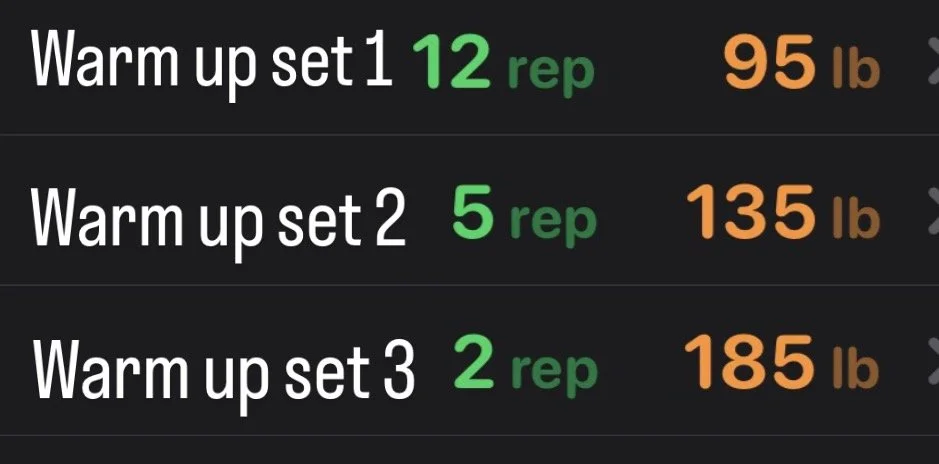
Three warm up sets at 50-70-90% of the working set weight
2. Working Sets With Small Increases
For most of us, the optimal number of working sets is three to four. Instead of jumping straight to your heaviest weight on the first set:
Start with your lightest set – a weight you can hit your rep target 95% of the time.
Add small, intentional weight increases each set (five lbs or less)
Keep reps consistent (optimally 6, 7, or 8 reps)
Maintain clean technique on every set
Use a spotter if possible but don’t force reps after failure
Here is a breakdown of my most recent bench press work. This day’s workout plan was to complete 4 working sets of 8 reps.
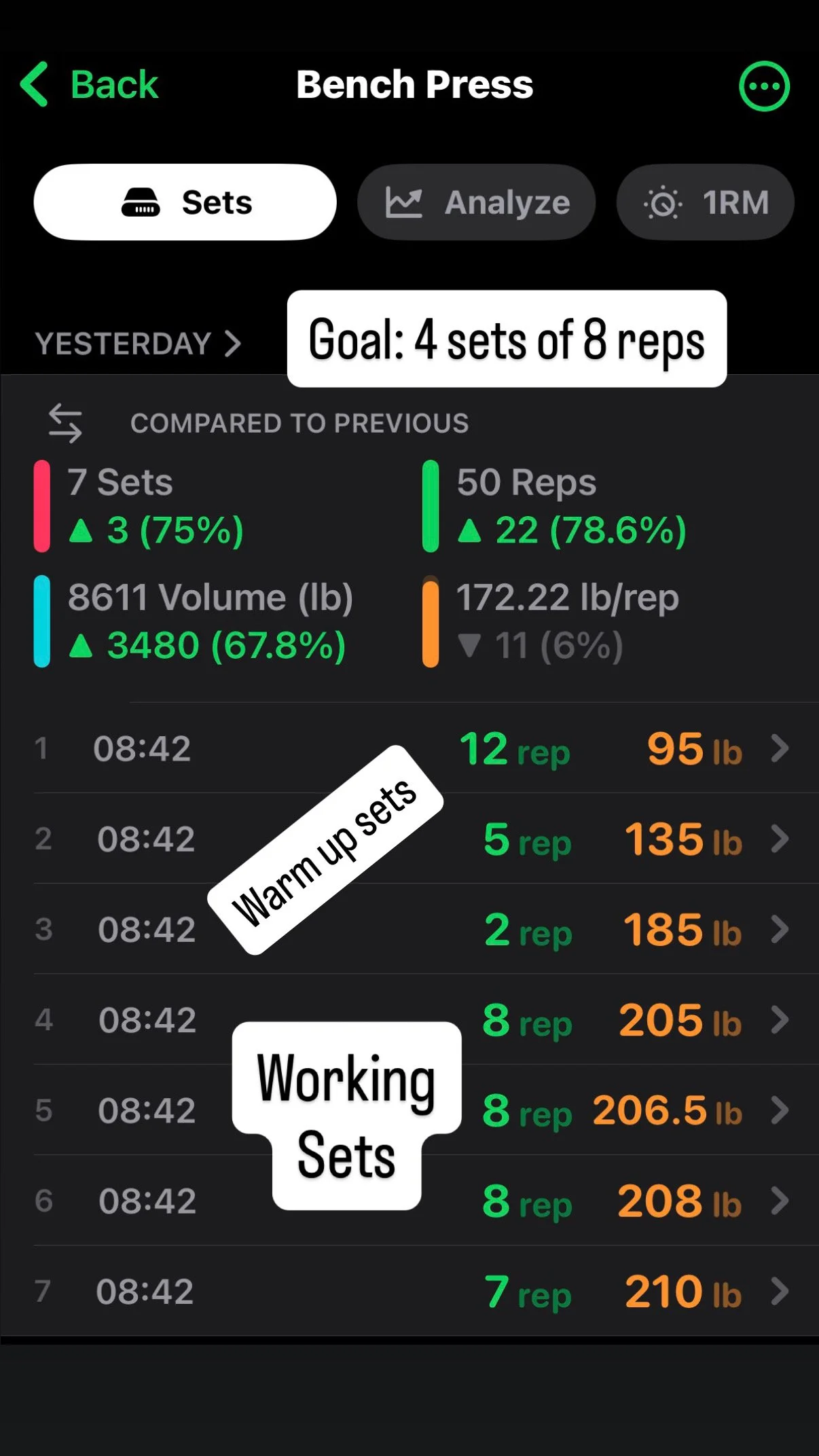
I use Set Graph to track my sets.
You can see it was close, but on the final set I was only able to complete 7 of the 8 planned reps. And that’s ok because I completed 8 reps on the first three sets and my effort took me within one rep on the last set — so that sets the bar for the next workout.
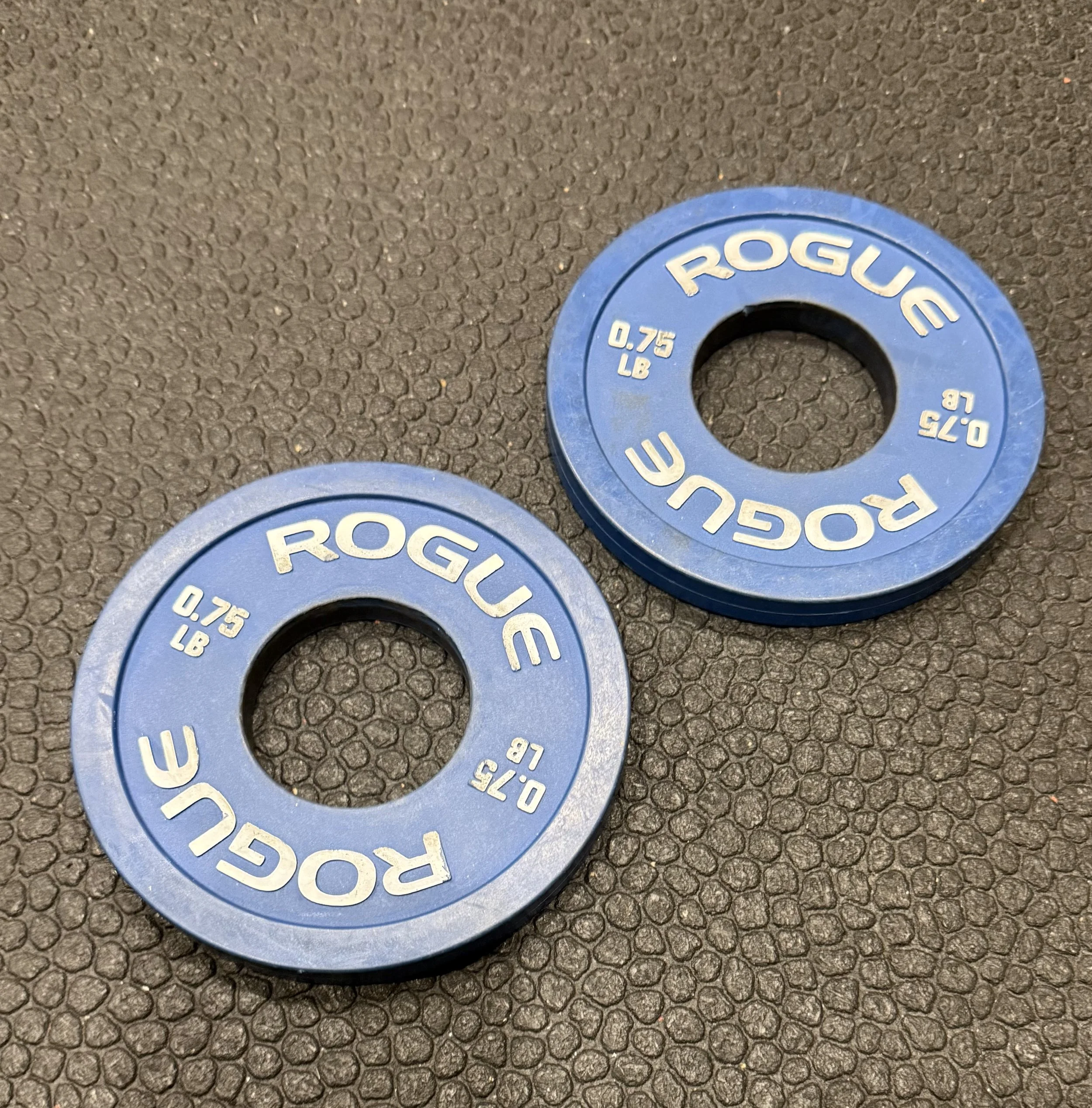
I also invested in these 0.75 lb mini plates (a set of 4). This allows me to go up 1.5 lbs each set versus 5 lbs per set. Those small jumps add up — without forcing breakdowns in form.
3. Technique Comes First
Progressive overload only works if:
The bar path stays consistent
Your shoulders remain stable
Your core and leg drive support the press
If form slips, the overload stops working. Maintaining form can be a challenge. Staying grounded and focusing on breathing technique is key. Reach out and let me know if you need some help with form and technique.
Common Mistakes to Avoid
If progressive overload hasn’t worked for you in the past, it’s often because of one of these:
Jumping weight too aggressively
Skipping warm-up sets
Chasing ego lifts instead of quality reps
Ignoring recovery between sessions
Remember: progress isn’t rushed — it’s repeated.
The Big Takeaway
Progressive overload isn’t about lifting the most weight in the room.
It’s about:
Smart progression
Consistent effort
Respecting the process
When you layer technique on top of progression, strength becomes sustainable — and confidence follows.
Coming Up Next
On future Technique Tuesday posts, I’ll break down:
Cues to help you perform exercises properly
Exercise variations with dumbbells, barbells, cables, bands
Deep dive into specific exercises

If you have questions or want a specific lift broken down, drop a comment or send me a message — I love helping you train smarter.
Keep ridin’ — Keep building. 💪